
Developmental Disabilities & the Most Common Mental Health Conditions
When you hear the term “residential services for people with disabilities,” what comes to mind? Is it the outdated image of a large institution, a generic group home, or something entirely different? For many, the traditional perception is one of isolation and confinement. However, the reality of modern residential services is a world away from this historical view. Today, these services are not about housing people away from society; they are about helping individuals build a fulfilling life within it.
This shift represents a fundamental change in philosophy—from a focus on simple care to one that empowers independence and fosters genuine social inclusion. This blog will explore how modern, person-centered residential services are actively challenging old paradigms, enabling individuals with intellectual and developmental disabilities (IDD) to live as integral, contributing members of their neighborhoods. We will see how this approach not only benefits the residents themselves but also enriches the entire community by fostering diversity, understanding, and compassion.
From Institution to Integration: A Paradigm Shift in Care
For much of the 20th century, the standard model of care for individuals with disabilities was institutionalization. This mode often led to profound isolation, a lack of personal autonomy, and a loss of connection to family and community. Thankfully, a massive movement toward deinstitutionalization over the past few decades has replaced this outdated approach with a new, more human-centered vision.
Today, the goal is to create a "home" within the community, not just a place to live. This paradigm shift has given rise to a variety of modern residential services designed to meet diverse needs while prioritizing community living. These options are deliberately decentralized, ranging from apartment-style living with flexible support to small, shared homes that foster a supportive, family-like environment.
Among the most common models are supported living, which provides staff assistance to individuals in their own community residences, promoting maximum autonomy, and modern group homes, which are reframed as supportive, shared living environments. These contemporary settings are a far cry from their institutional predecessors. They are designed to blend into neighborhoods, giving individuals with disabilities the same right to choose where they live as anyone else.
The data overwhelmingly support this shift. Decades of research have consistently shown that people who move from institutions to smaller, community-based settings are healthier, happier, and have more control over their lives. A comprehensive review of outcomes for individuals with IDD found that those living in more dispersed, individualized settings show greater signs of community integration and higher levels of life satisfaction. This evidence solidifies the understanding that true well-being is intrinsically tied to one's environment and the ability to be a part of a community.
The Power of Choice: Empowering Independence Through Skill Building
So, what does it mean to be truly independent? It's often misunderstood as the ability to do everything alone. In reality, true independence is about having the skills and confidence to make choices about your life and receive support to achieve your goals. Modern residential services are built on this very principle.
These services go far beyond providing a roof over one's head. They serve as a launchpad for personal empowerment and skill-building, focusing on the practical, hands-on support that helps individuals with IDD navigate daily life. This can include anything from managing finances and preparing healthy meals to using public transportation and adhering to a medication schedule. This training isn't just about a list of tasks; it's about giving individuals the tools they need to live a self-directed life. For a deeper look at what this looks like, you can explore the various programs designed to enhance independence and skill-building for individuals with IDD.
The impact of this approach is tangible and profound. Individuals who gain greater choice and control over their daily routines and living arrangements report significantly higher levels of life satisfaction and self-esteem. A study published in the American Journal on Intellectual and Developmental Disabilities found that individuals with IDD living in their own homes or small, supported residences consistently reported more autonomyand satisfaction than those in larger, more restrictive settings.
Imagine the sense of accomplishment for an individual who, with the help of a supportive team, learns to navigate the aisles of a grocery store, plan a week's worth of meals, and cook their own dinner for the first time. That moment of pride is the result of a system built on dignity, respect, and the belief that every person has the capacity to grow. These are the small victories that add up to a life of greater freedom and fulfillment.
Weaving a New Tapestry: How Residents and Neighbors Benefit
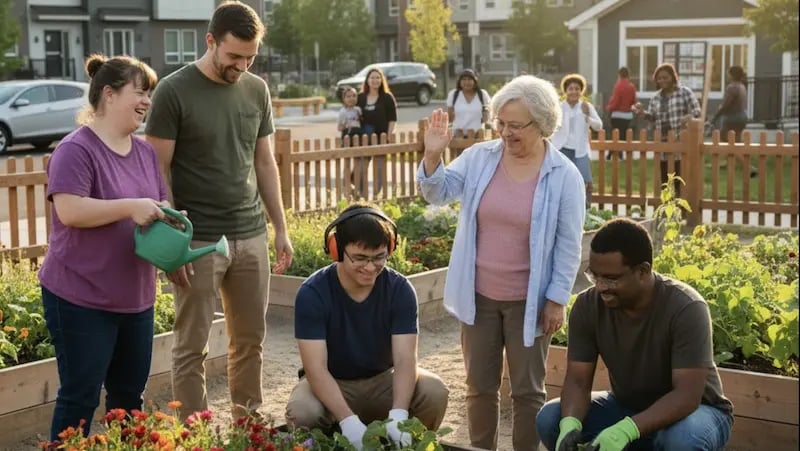
True community integration is not a one-way street. It is a reciprocal relationship where residents and their neighbors engage with and learn from one another. Modern residential services are designed to facilitate this process, helping individuals with disabilities connect with their neighbors, not just their direct support professionals. This intentional focus helps to break down the social isolation that has long plagued this population.
This can be seen in countless small but meaningful ways. It might involve an individual joining a local book club, participating in a neighborhood clean-up day, or simply becoming a regular at the local coffee shop. These actions help individuals build natural supports—the unpaid, organic relationships with friends, neighbors, and community members that are essential to a meaningful life. The goal is to ensure that individuals with IDD are not just living in a community but are truly a part of it.
Research confirms the power of this approach. Data from the Centers for Disease Control and Prevention (CDC) and other sources indicate that individuals with disabilities who have strong social networks and community connections report better mental and physicalhealth outcomes. In addition, a growing body of evidence shows that when people with disabilities are visible and active in their neighborhoods, it fosters a more acceptingand compassionate society. These interactions break down old stereotypes and help people see beyond a disability, recognizing the individual's unique talents, personality, and contributions.
When a community welcomes a person with disabilities, it gains a new perspective. It becomes a richer, more diverse place where the fabric of life is woven with different experiences and abilities. In this way, modern residential services are not simply a social safety net; they are catalysts for building stronger, more empathetic, and genuinely inclusive communities for everyone.
The Path Forward: A Vision Where Everyone Thrives
The outdated image of residential services is fading, replaced by a vibrant vision of modern, community-based care. We have seen how this person-centered approach provides the foundation for independence, the tools for self-determination, and the pathways for true social inclusion. It's a vision built on the belief that every person, regardless of their ability, deserves the opportunity to choose their path, pursue their passions, and be an active member of their community.
This is the very philosophy that guides CRi, a nonprofit organization with 50 years of experience in the field of social services. Our mission is to support individuals with intellectual and developmental disabilities (IDD) and mental health challenges to live self-determined lives within their communities. Our extensive community living options and personalized supports are designed to help individuals with IDD and mental health conditions find the right fit for their lives. We believe that by offering tailored support—from independence and skill-building to help with thriving in the community—we can make this vision a reality.
The future of residential services is not just about where people live, but about how they live. It’s about building a future where everyone has the opportunity to thrive and contribute. We invite you to learn more about our mission and discover how we work every day to create a more inclusive world.